
Existing Facility
A 21st Century School to Serve Franklin County Well into the Future
Franklin County Technical School is looking forward to celebrating our 50th anniversary in 2026 and since the day we opened our doors the school has faithfully and proudly served students from communities throughout Franklin County and beyond.
As we celebrate our past, we must also look to the future. From the beginning of this project, FCTS explored the most cost-effective options to adequately meet our needs for a modern educational facility that will best serve our students.
We considered a number of alternatives, including new construction, upgrades and repairs to the existing building, and building an addition and making renovations to the existing building.
After years of study, evaluation and extensive consultation, we strongly believe the construction of a new building would be our best option to meet all of our space and educational needs.
Why Does Franklin County Technical School Need a New Building?
Franklin County Technical School (FCTS), built in 1975, has served the community well for nearly 50 years. However, the building has reached the end of its useful life, and critical systems are failing. Independent reviews by the Massachusetts School Building Authority (MSBA) have confirmed that the facility is no longer adequate to support modern educational needs, which is why FCTS was accepted into the MSBA building project system. If a new building is not approved, the district will be forced to invest in a series of extraordinarily expensive infrastructure projects—each addressing outdated and deteriorating systems, but none solving the underlying problem of a rapidly aging facility. The current building does not support the current academic program, with insufficient space and overcrowding restricting education and presenting safety challenges. The building's layout does not provide an effective separation between public and academic areas, limiting the ability to maintain a secure environment for students and staff.
Below Are the Most Pressing Structural Problems:
-
Roof System
The school’s 160,000 sq. ft. roof has already undergone two major projects in the last 30 years, including a Cyclone roof coating 9 years ago. Since this option has already been used twice, the only viable next step is a complete tear-off and rebuild. This would involve replacing insulation, membranes, flashings, drains, and reinstalling all rooftop mechanical equipment. This single project would be among the largest capital expenditures the district has ever faced. The estimated cost of this work alone would likely trigger the requirement for a full building code upgrade. Under those circumstances, the district would not have the option to proceed with only a partial code upgrade and would instead be required to bring the building into full code compliance.
-
Electrical System
FCTS still relies on outdated Federal Pacific breakers and switchgear, which are no longer manufactured and have already begun failing. Each replacement has cost between $50,000–$100,000, with $200,000 already spent on just two failures. More than a dozen vulnerable units remain. Without a full replacement, a catastrophic failure could force the school to close for weeks or months. A full electrical system replacement would include new switchgear, panels, distribution, and backup generators.
-
Plumbing, Water, and Sewage
All underground plumbing, water, and sewage systems are original to 1975. Breaks and leaks have already caused sewage hazards and odors under the building, disrupting the learning environment and creating health risks. These issues will worsen over time, increasing both cost and disruption.
-
Fire Sprinkler System
To comply with modern fire safety codes, FCTS would require a new wet-pipe sprinkler system across all 160,000 sq. ft. of the facility. This would include risers, piping, seismic bracing, new sprinkler heads, and a fire pump with upgraded water service. Full integration with the fire alarm and electrical systems would also be required. Because the building would remain occupied during construction, phased work and extensive safety precautions would add to the complexity and cost.
-
Hazardous Materials Abatement
FCTS will be responsible for hazardous materials abatement that complies with state regulations. Materials such as oil, chemicals and other hazardous materials that pose a health risk or are damaging to the environment will need to be assessed and cleaned up.
Conclusion
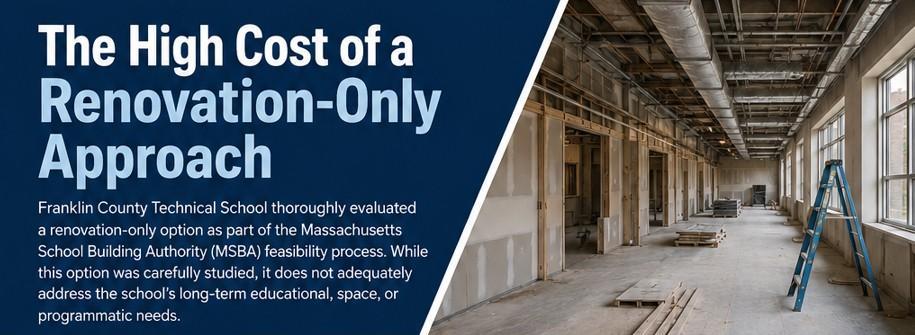
If the community does not move forward with a new building, Franklin County Technical School will face unavoidable capital projects of infrastructure replacement and code upgrades to keep the existing 1975 facility operational. With the added cost of phasing, rental of temporary classrooms and an extended construction timeline, the project would cost roughly $125.3 million. These projects would cause prolonged disruption to students and staff while consuming resources that could otherwise be invested in a modern school designed for today’s educational and workforce training needs.